No-Fail Homemade Ciabatta Loaf with Open Crumb
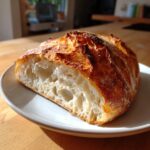
Follow this straightforward tutorial to bake an authentic, rustic Italian bread loaf with the characteristic open, airy crumb structure in your home oven.
- Prep Time: 20 min
- Cook Time: 35 min
- Total Time: 17 hours 5 min (includes 16 hours for poolish)
- Yield: 2 medium loaves 1x
- Category: Bread
- Method: Baking
- Cuisine: Italian
- Diet: Vegetarian
Ingredients
Scale
- 1 cup (240g) water, room temperature (for the poolish)
- 1 cup (120g) bread flour (for the poolish)
- 1/4 teaspoon instant dry yeast (for the poolish)
- 2 cups (240g) bread flour (for the main dough)
- 1 cup (240g) warm water (105-115°F or 40-46°C) (for the main dough)
- 1 teaspoon instant dry yeast (for the main dough)
- 2 teaspoons fine sea salt
- Extra flour or semolina for dusting
Instructions
- Prepare the Poolish: In a medium bowl, mix the 1 cup water, 1 cup bread flour, and 1/4 teaspoon yeast until just combined. Cover the bowl loosely with plastic wrap and let it sit at room temperature for 12 to 16 hours until very bubbly and active. This is your pre-ferment.
- Mix the Dough: In a large mixing bowl, combine the remaining 2 cups of bread flour, the 1 cup warm water, and 1 teaspoon of yeast. Add the entire poolish mixture. Mix with a wooden spoon or spatula until a shaggy mass forms and no dry flour remains. Let this mixture rest, covered, for 30 minutes (autolyse).
- Add Salt and Mix: Sprinkle the salt over the dough. Using wet hands, perform a series of stretch and folds directly in the bowl for about 2 minutes. Gently stretch a portion of the dough up and fold it over the center. Rotate the bowl and repeat until you have folded all sides.
- Bulk Fermentation: Cover the bowl and let the dough rest for 3 hours at room temperature. During this time, perform stretch and folds every 30 minutes for the first 90 minutes (three sets total). The dough will become noticeably more airy and developed.
- Divide and Shape: Lightly flour a work surface. Gently scrape the wet dough out onto the surface. Do not punch it down. Lightly dust the top of the dough with flour. Using a bench scraper, gently divide the dough into 2 or 3 equal pieces. Gently stretch each piece into a rough rectangle shape, being careful not to force out all the gas.
- Final Proof: Generously dust a piece of parchment paper or a linen couche with flour or semolina. Carefully transfer the shaped dough pieces onto the prepared surface, leaving space between them. Cover loosely with plastic wrap or a clean kitchen towel. Let proof for 45 to 60 minutes until puffy.
- Preheat Oven: About 45 minutes before baking, place a baking stone or heavy baking sheet on the middle rack. Place a shallow metal pan on the bottom rack. Preheat your oven to 475°F (245°C).
- Bake: Carefully slide the parchment paper with the loaves onto the preheated baking stone. Pour 1 cup of hot water into the shallow pan on the bottom rack to create steam. Immediately close the oven door.
- Steam Bake: Bake for 15 minutes with the steam. After 15 minutes, carefully open the oven door to release the steam (remove the water pan if possible, or just open the door briefly). Reduce the temperature to 450°F (230°C) and continue baking for another 15 to 20 minutes, until the crust is deep golden brown.
- Cool: Transfer the baked ciabatta loaves to a wire rack to cool completely before slicing.
Notes
- The high hydration level (around 80%) is what creates the open crumb structure. Work with wet hands when handling the dough.
- If you do not have a baking stone, you can use an overturned heavy baking sheet.
- For a crispier crust, you can spray the inside walls of the oven with water once during the first 5 minutes of baking.
Nutrition
- Serving Size: 1 slice
- Calories: 180
- Sugar: 0.5
- Sodium: 250
- Fat: 0.5
- Saturated Fat: 0.1
- Unsaturated Fat: 0.4
- Trans Fat: 0
- Carbohydrates: 38
- Fiber: 1.5
- Protein: 6
- Cholesterol: 0
Find it online: https://dishicious.com/homemade-ciabatta-loaf-recipe/